
America
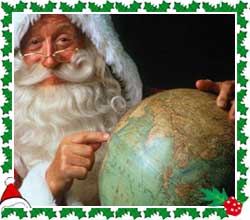 Dutch settlers brought the tradition and importance of Saint Nicholas (Sinter Klaas) to America in the 17th century where some people mispronounced it as Santa Claas which was later popularized as the present 'Santa Claus'. Here, he was transformed from an austere bishop to a jolly old elf. After Dutch brought Saint Nicholas to America, he was gradually transformed from an austere bishop to a fat-bellied jolly man. The credit for the present jolly image of Santa Claus goes to two people, political cartoonist 'Thomas Nast' and poet 'Clement Clarke Moore'.
Germany
In Germany, people celebrate the Santa Claus concept by different names. "Weihnachtsmann" or "Nikolaus" is observed on a small scale who is believed to be Saint Nicholas that fills Children's boots with gifts on December 6 (Saint Nicholas Day). "Christindl" brings and distribute gifts amongst people on Christmas Eve (December 24).
Sweden & Denmark
In Sweden, Santa is referred to as "Jultomten", a gnome whose sleigh is drawn by the Julbocker, the goats of the Thor, the god of thunder. He dresses in red and carries a bulging sack of gifts on his back. However in Denmark, he is known as a gift bringer, named "Julemanden", who also carries a sack stuffed with gifts and is drawn by reindeers.
Netherlands
In Netherlands, St. Nicholas Day evening (Sinterklaasavond) is more important than Christmas. Though some Dutch people have started celebrating Christmas Eve with Santa but "Sinterklaas" (Saint Nicholas) is more important. Sinterklaas distributes gifts on the evening of December 6 and wears a red bishop's dress including red mitre, riding a white horse over rooftops. The traditional Dutch presents include a figurine of Sinterklaas made out of chocolate and wrapped in painted aluminum foil.
Russia
In Russia, Santa Claus is identified as Ded Moroz (Grandfather Frost). However, they celebrate the same ageless vagrant as 'Baboushka'. She was the one who gave the wise men the wrong directions and on the eve of Three Kings Day, she wanders from house to house, peering into the faces of children and leaving gifts.
European Countries
In most European countries, Santa Claus is generally celebrated as Father Christmas. English children wait for Father Christmas, known to their ancestors as Christmas itself. In France, gifts are brought by Father Christmas, Pre Noel, or the Christ Child himself. In Austria and Switzerland, the Christkindl distributes gifts.
Names for Santa Around the World
Belgium : Pere Noel
Brazil : Papai Noel
Chile : Viejo Pascuero ("Old Man Christmas")
China : Shengdan Laoren. ("Christmas Old Man")
Costa Rica : el Nicesus or el Niņo Jesus, "the infant Jesus".
Denmark : Julemanden
Netherlands : Kerstman
Finland : Joulupukki
France : Pere Noel
Germany : 'Weihnachtsmann' ("Christmas Man") or 'Nicholas' at December 6 and 'Christindl' at 24 December, distributing gifts amongst people.
Hawaii : Kanakaloka
Hungary : Mikulas (St. Nicholas)
Italy : Babbo Natale
Japan : "Santa no ojisan", (Uncle Santa)
Mexico : el Nicesus
Norway : Julenissen ("Christmas gnome")
Poland : Swiety Mikolaj (St. Nicholas)
Peru : Papa Noel
Russia : Ded Moroz ("Grandfather Frost")
Spain : el Nicesus
Sweden : Jultomten ("Christmas brownie")
U.K. : Father Christmas